
North American Crop Conditions
- Monday, June 9, 2003
This analysis featured in the JUNE 9, 2003 issue of the HGCA's MI Prospect, Volume 5, Number 25
While both the US and Canada now expect at least average yields and a significant increase in output from last year's drought reduced levels, this is needed to meet recent consumption trends and to build stocks from currently low levels.
Typically by the end of May the US winter wheat harvest is well underway in Texas, while at the other end of continent on the Canadian Prairies farmers' are completing the last of their spring seeding. Thus, harvest prospects for much of the US winter wheat belt are largely set, as are often critical conditions for spring crop establishment. North American crop prospects are therefore taking shape.
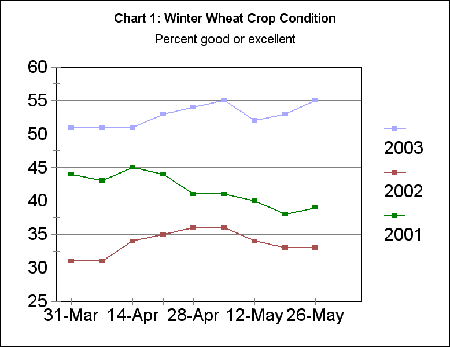
US Winter WheatThe condition of the US winter wheat crop has been relatively favourable since it emerged from dormancy, and has been much improved from 2001 and 2002 (Graph 1). At the beginning of June it was reported to be in good to excellent condition by 53 percent of crop reporters. This compares with 39 and 31 percent at the same time in 2001 and 2002. Only in Texas have last year's drought conditions returned.
continueChart 1
Source: USDA
continued
Early in the month the USDA, based on surveys, projected a 44 million tonne winter wheat harvest, an increase of 37 percent from the drought-reduced crop of 2002, with higher area, reduced abandonments and higher yields. As crop conditions have not changed materially since then and much of the crop is now in the ripening phase, final production estimates are unlikely to vary much from this projection. A crop of this size in an historic context would only be regarded as average. Further, the increase from a year ago does little more than allow a catch up on consumption trends with some rebuilding of low stock levels after two years when drought has been a limiting factor.
US Spring Crops
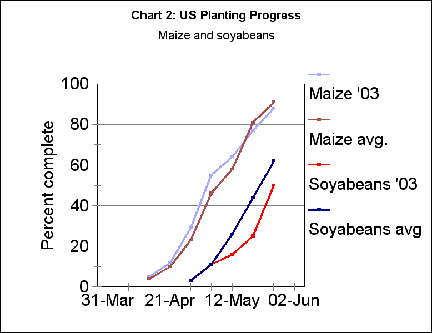
Planting of US spring wheat, maize and soybeans were reported to be 97, 95 and 74 percent complete at the beginning of June. As the result of a wet spell in mid May planting of maize and particularly soybeans fell behind normal for a while, but the moisture will probably be beneficial for crop development(see Chart 2). The delay in planning was probably not sufficient to cause a general switch in planned acreage from maize to soybeans by farmers, although recent market price trends may have encouraged this in some situations.
continueChart 2
Source: USDA
continued
In the USDA's first weekly survey of spring crop conditions, 81 and 68 percent of reporters placed crop conditions in the good to excellent range, respectively for spring wheat and maize. Respective percentages for 2002 were 55 and 54 percent.
While it is too early to make a definitive forecast on spring crop production, the USDA has made projections based on 5-year average harvested-to-planted ratios and yields and Prospective Plantings survey areas. The 13 to 14 million tonne projection for spring wheat is about 12 percent above the 2002 harvest despite a smaller area. In view of the high proportion of the crop in good or excellent condition the projection may prove to be conservative. This has more implications for protein scales than more general price prospects.
In the case of maize and soybeans crops which have four and five months of development ahead of them, the projections are little more than a bench mark. At 255 million tonnes the US corn crop is projected to be about 11 percent larger than in 2003. For soybeans the 2003 projection is for 78 million tonnes compared with 74 last year. Crop emergence is behind the long term average almost certainly because the slower planting progress earlier. But the corn crop is reported to be in better condition than a year ago.
Market prospects
Despite the generally improved US production prospects over the last two months, the market outlook as reflected in new crop futures prices has improved. Both wheat and soybean prices have increased by about 10 percent, and maize prices are up about five percent. While some of this reflects the weakness of US dollar, carry-over stocks are not burdensome, the US wheat crop will not be a large one in an historic context and it is generally anticipated that the growth in demand for soybeans and maize with absorb the forecasted increases in production.
Canadian Crops
Canadian spring seeding was also well advanced by the end of May - 90, 75 and 60 percent complete, respectively in Manitoba, Saskatchewan and Alberta. Moisture conditions are generally much improved as a result of above average rain and snow over winter and into the spring(See Map).
continueMap
 Source: Canadian Prairie Farm Rehabilitation Administration
continued
Manitoba crops have emerged in many areas with excellent moisture. Seeding in Saskatchewan has caught up to normal progress with moisture conditions also favourable. While Alberta progress is about a week behind normal the delays are generally seen as beneficial for yield prospects as they have resulted from above normal rain and snow this spring and wet field conditions. In late May surface soil conditions were reported to be 80 percent good or excellent and sub surface moisture at 60 percent good or excellent. Concern over sub surface moisture is now limited to a relatively small area where the drought was most severe last year.
The delay in seeding in Alberta may have encouraged farmers to switch from wheat to barley and canola which are less sensitive to late seeding. Also wheat is generally regarded as more drought tolerant and the improved moisture may also have resulted in some adjustments in seeding plans. But these shifts are unlikely to be significant in an overall Canadian context.
Two months ago an average harvest was possible. It should now be regarded as probable.
In the two sectors of the cereals market where Canadian harvests are important, hard red spring wheat and malting barley, at least an average harvest is needed to both meet ongoing demand and to very low carryover stocks. The Canadian Wheat Board (CWB) is, therefore, relatively optimistic about market prospects.
The Canadian dollar, in contrast to its US counterpart, has been very strong in recent months. And it is this, rather than more general market prospects, that has prompted the CWB to revise downwards its Pool Return Outlooks(PRO) for 2003-04. For the top grade of spring wheat its is forecasting a return of Can$210 per tonne compared to Can$258 for this year.
For malting barley, Special Select 2-Row, it is currently projecting a pool return of Can$198, the equivalent of about £86, per tonne at tide water. While this is 20 percent lower than last year's PRO, it would be an above average return in a 15-year context.
David Walker
phone: 01603 705153
top of page